
Commercial Mediation for Startups: 7 Key Benefits
Table of Contents
- Why Commercial Mediation Matters for Startups
- 7 Key Benefits of Commercial Mediation for Startups
- Mediation vs Litigation for Startups: Understanding Your Options
- How Long Does Commercial Mediation Take?
- Cost of Business Mediation: What Startups Should Expect
- Preparing for Commercial Mediation: A Startup Checklist
- Common Misconceptions About Commercial Mediation
- Conclusion: Taking the First Step Toward Resolution
Commercial Mediation for Startups: 7 Key Benefits
Last Updated: July 12, 2026
Why Commercial Mediation Matters for Startups
Startups face relentless pressure from partnerships and contractual obligations. When disputes emerge, most founders assume litigation is the only path forward, a costly mistake. According to American Bar Association data on dispute resolution, businesses pursuing litigation spend 18-24 months in court while operations stall and relationships deteriorate. Commercial mediation offers a fundamentally different approach: interest-based negotiation instead of winner-take-all legal battles.
This guide covers seven key benefits of commercial mediation for startups, from cost savings and speed to relationship preservation and creative problem-solving.
7 Key Benefits of Commercial Mediation for Startups
1. Cost-Effectiveness and Protecting Your Bottom Line
Litigation drains startup capital at rates most founders don’t anticipate. Court cases require extensive legal fees, discovery costs, expert witnesses, and depositions, often exceeding $50,000 to $250,000 for moderately complex disputes. Mediation typically costs a fraction of that amount because the process is collaborative rather than adversarial.
Commercial mediation achieves resolution in days or weeks, not years. Both parties share the mediator’s fee, avoiding expensive discovery, depositions, and court filing fees. For early-stage companies operating on tight margins, this cost difference is often the deciding factor.
2. Speed: Resolving Disputes Without Court Delays
Court dockets are congested. A startup filing a lawsuit today might not see trial for 2-3 years. By then, the business landscape has shifted entirely. Commercial mediation resolves disputes in weeks or months, allowing startups to move forward without the grinding uncertainty of litigation.
3. Preserving Business Relationships and Trust
Many startup conflicts involve co-founders, business partners, investors, or vendors with whom you may need to work in the future. Litigation is inherently adversarial, positioning parties as enemies and producing winners and losers. Mediation operates under a different philosophy: a neutral mediator facilitates conversation aimed at mutual understanding, not victory.
Both parties remain in control of the outcome and can explore creative solutions litigation never permits. A co-founder dispute, for example, might resolve through a buyout, revised equity split, or clear governance framework, outcomes that preserve the business and allow parties to move forward with dignity.
4. Confidentiality and Privacy Protection
Litigation is a public process. Court filings, testimony, and verdicts become part of the public record. For startups, this exposure can be devastating. Confidential business information, financial details, strategic plans, and customer data may all become discoverable.
Commercial mediation is entirely confidential. Nothing said in mediation can be used in court later. The mediator’s notes are privileged. Settlement agreements remain private. This confidentiality allows both parties to speak honestly and reach agreements that would never survive public scrutiny.
5. Control Over the Outcome
In litigation, a judge or jury decides the outcome. You’ve surrendered control to the legal system and may receive a verdict you don’t like. Mediation inverts this dynamic: you and the other party control the outcome. The mediator facilitates conversation, but both sides must agree to any settlement. If you don’t like a proposed solution, you reject it.
In mediation, you can agree to payment plans, ongoing relationships, non-compete clauses, confidentiality terms, or any creative arrangement both parties find acceptable. Courts are limited to monetary damages or injunctions.
6. Flexibility and Creative Solutions
Litigation produces binary outcomes: you win or lose on the issues the court decides. Mediation produces custom agreements designed around the actual interests of both parties.
Consider a partnership dispute where one founder wants to exit and the other wants to continue. Litigation might award damages, but it doesn’t solve the operational problem of who runs the company. Mediation allows parties to negotiate a buyout, phased transition, management restructure, or complete dissolution, any arrangement addressing both parties’ real interests.
7. Risk Management and Predictability
Litigation is inherently unpredictable. Even strong cases can fail. Juries are unpredictable. Judges interpret law differently. Appeals extend timelines and costs. Mediation reduces this uncertainty because both parties negotiate from their actual positions and interests. The result is a settlement both parties find acceptable because both have agreed to it.
Mediation vs Litigation for Startups: Understanding Your Options
When a startup faces a commercial dispute, three paths emerge: negotiation, mediation, and litigation.
Negotiation is direct discussion between parties, often with lawyers present. It’s fast and inexpensive but often reaches an impasse when parties are entrenched.
Mediation introduces a neutral third-party to facilitate conversation, explore interests, and craft solutions. It preserves relationships, maintains confidentiality, and produces custom agreements. Both parties control the outcome.
Litigation is formal court proceedings where a judge or jury decides the outcome. It’s expensive, time-consuming, public, and adversarial. It should be the last resort, not the first response.
Dispute Path | Timeline | Cost | Confidentiality | Outcome Control | Relationship Impact |
|---|---|---|---|---|---|
Negotiation | Days to weeks | Minimal | Private | High | Positive if successful |
Mediation | Weeks to months | Low to moderate | Fully confidential | High (both parties agree) | Preserved |
Litigation | 18-24 months | High to very high | Public record | None (judge/jury decides) | Destroyed |
For startups, mediation sits in the optimal middle ground. It’s fast and affordable like negotiation but introduces a neutral party when direct negotiation stalls.
How Long Does Commercial Mediation Take?
Most startup disputes resolve within 30-90 days from initial contact to final settlement agreement.
A typical mediation process unfolds in phases:
Pre-mediation (1-2 weeks): Both parties agree to mediate. The mediator receives background information and position statements.
Initial mediation session (2-4 hours): Both parties meet with the mediator. Each side presents their perspective. The mediator identifies common ground and core interests. Parties often caucus separately with the mediator to explore options privately.
Follow-up sessions (typically 2-4 additional sessions): Parties and mediator continue exploring solutions. Offers and counteroffers are exchanged as parties move closer to agreement.
Settlement agreement (1-2 weeks after final session): Once parties reach agreement in principle, lawyers draft the formal settlement agreement. Both parties review and sign.
For straightforward disputes, mediation might conclude in a single session. For complex cases, mediation might require 4-6 sessions over 8-12 weeks.
Cost of Business Mediation: What Startups Should Expect
Mediation costs depend on dispute complexity, mediator experience, location, and number of sessions required. Both parties typically share the mediator’s fee equally.
For most startup disputes, mediation costs fall in the range of a few thousand dollars total, split between both parties. This covers the mediator’s hourly rate (typically $200-$400 per hour for experienced commercial mediators) and session time. A dispute resolving in three 3-hour sessions with a $300/hour mediator costs roughly $2,700 total, or $1,350 per party.
Compare this to litigation, where a single lawyer billing $250-$400 per hour can easily cost $5,000-$10,000 per month for 12-24 months.
Preparing for Commercial Mediation: A Startup Checklist
Before the Mediation Session
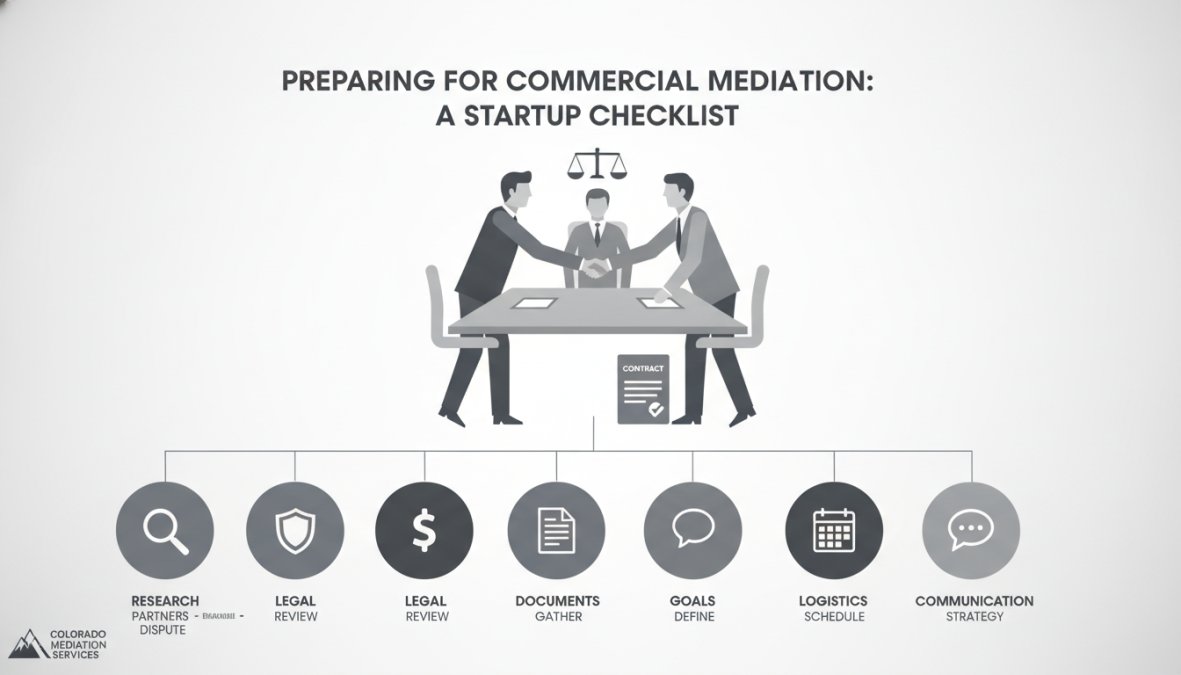
Preparation dramatically improves mediation outcomes. Both parties should arrive informed, organized, and ready to negotiate.
Understand your interests, not just your position. Your position is what you’re asking for. Your interest is why you want it. Clarify your interests before mediation begins.
Gather all relevant documents. Contracts, emails, financial records, and correspondence tell the dispute’s story. Organize these materials chronologically.
Assess your BATNA (Best Alternative to Negotiated Agreement). What happens if mediation fails? Understanding your BATNA helps you evaluate settlement offers during mediation.
Brief your legal counsel. Ensure they understand mediation’s collaborative nature. Lawyers should come prepared to explore options, not just defend positions.
Set realistic expectations. Mediation won’t give you everything you want. It will give you something better than litigation’s uncertainty.
During Mediation: What to Expect
The mediation session follows a structured format designed to facilitate productive conversation.
Opening remarks: The mediator explains the process, confidentiality rules, and ground rules.
Opening statements: Each party presents their perspective on the dispute. The mediator listens for interests beneath positions.
Caucuses: The mediator meets separately with each party and their lawyer. This is where honest conversation happens. Parties can share concerns, explore options, and test ideas without the other side present.
Offer and counteroffers: Through caucuses, parties exchange proposals. The mediator carries offers back and forth, helping each side understand the other’s perspective.
Settlement agreement (if reached): Once parties agree on all terms, lawyers draft the settlement agreement. Both parties review and sign.
Post-Mediation Implementation and Settlement Agreements
Once parties reach agreement in mediation, the settlement agreement becomes binding.
Draft the formal agreement: Lawyers translate the mediated agreement into legal language, specifying all terms: payment amounts, timelines, ongoing obligations, confidentiality clauses, and dispute resolution procedures.
Execute the agreement: Both parties sign the settlement agreement.
Communicate internally: Once the settlement is final, inform your team, board, and relevant stakeholders. This signals stability and allows the organization to move forward.
Monitor compliance: Ensure both parties fulfill the settlement terms. Most settlements include a clause allowing either party to seek enforcement if the other party breaches.
Common Misconceptions About Commercial Mediation
Myth: Mediation is just negotiation with a middleman. Reality: A mediator helps parties understand each other’s interests, identify creative solutions, and move past emotional impasses.
Myth: Mediation means splitting the difference. Reality: Mediation produces custom agreements tailored to both parties’ actual interests.
Myth: If I go to mediation, I’m admitting weakness. Reality: The strongest negotiators use mediation because they understand its efficiency.
Myth: Mediation is only for disputes where both parties want to cooperate. Reality: Mediation works even when parties are hostile. The mediator’s role is precisely to facilitate communication when direct negotiation has broken down.
Myth: If mediation fails, I’ve wasted time and money. Reality: Even failed mediation provides value. Both parties gain clarity about the other side’s position.
Myth: The mediator will decide who’s right. Reality: Mediators don’t judge or decide. Only the parties can agree to a settlement.
Conclusion: Taking the First Step Toward Resolution
Startup disputes don’t resolve themselves. Left unaddressed, they metastasize into litigation, destroying relationships, consuming capital, and diverting leadership focus from growth. Yet most founders assume litigation is the only path forward, not realizing that commercial mediation offers a faster, cheaper, more relationship-preserving alternative.
Colorado Mediation Services specializes in commercial disputes affecting startups and business owners. We use interest-based mediation to help parties move past adversarial positions toward custom agreements that actually work for their businesses. Our approach is confidential, legally grounded, and designed specifically for the needs of founders navigating complex partnerships, contract disputes, and investor conflicts.
If you’re facing a commercial dispute, don’t assume litigation is inevitable. Book a courtesy call with Colorado Mediation Services to explore whether mediation is the right path for your situation.
Frequently Asked Questions
What is commercial mediation for startups?
Commercial mediation is an alternative dispute resolution process where a neutral third-party mediator helps startup owners and business partners resolve disputes without going to court. The mediator facilitates communication and negotiation to reach a mutually acceptable settlement agreement. Unlike litigation, mediation is confidential, faster, and focuses on finding creative solutions that preserve business relationships while protecting your assets.
How does mediation differ from litigation for small businesses?
Mediation is a collaborative dispute resolution process controlled by the parties, while litigation is adversarial and decided by a court verdict. Mediation typically costs less, takes weeks instead of years, and results remain private. Litigation involves formal proceedings, discovery processes, and public records. For startups with limited legal budgets, mediation offers cost-effective dispute mitigation while maintaining confidentiality and business continuity.
Is mediation legally binding for startups?
Mediation itself is non-binding—parties can walk away at any time. However, once both parties sign a settlement agreement reached through mediation, that agreement becomes binding and enforceable. This gives startups the flexibility to negotiate without commitment until they reach an acceptable resolution. Many startup disputes benefit from this approach because it reduces risk while allowing creative, interest-based solutions that court verdicts cannot provide.
How should I prepare for commercial mediation?
Prepare by documenting the dispute, identifying your interests (not just legal positions), gathering relevant contracts or agreements, and determining your best alternative if mediation fails. Consult with legal counsel beforehand to understand your rights. Organize key documents, set realistic settlement goals, and brief decision-makers who will attend. Effective preparation helps the neutral mediator facilitate productive negotiation and increases the likelihood of reaching an amicable resolution that protects your startup’s future.
