
Table of Contents
- Understanding Partnership Disputes and Their Root Causes
- Partnership Dispute Resolution Strategies That Work
- Mediation for Business Partners: A Practical Path Forward
- Partnership Agreement Clauses for Dispute Resolution
- Legal Options for Partnership Disputes Beyond Mediation
- How to Resolve Partnership Disputes Without Losing the Business
- Common Mistakes to Avoid When Resolving Partnership Disputes
- Conclusion: Your Next Steps
How to Resolve Partnership Disputes: A Practical Guide
Last Updated: July 20, 2026
When partnerships fracture, business operations stall, decision-making becomes impossible, and assets hang in limbo. Understanding how to resolve partnership disputes before they spiral into costly litigation is invaluable. This guide provides proven strategies for moving past blame toward solutions that preserve both the business and relationships.
Understanding Partnership Disputes and Their Root Causes
Partnership disputes develop gradually as misaligned expectations, unclear roles, and unspoken resentments compound over time. A specific incident, a financial decision, strategic pivot, or personnel conflict, often becomes the breaking point.
Common causes include:
Unequal effort or contribution. One partner perceives they’re investing more time, capital, or emotional energy than the other, especially common in early-stage businesses with unpredictable work rhythms.
Financial disagreements. Disputes over profit distribution, compensation, or reinvestment decisions create immediate friction and erode trust quickly.
Strategic direction conflicts. Partners envision different futures. One wants aggressive scaling; the other prioritizes stability.
Unclear roles and responsibilities. Undefined domains create turf wars over hiring authority, budget control, and client relationships.
Breach of fiduciary duty. A partner acts in their own interest rather than the partnership’s, pursuing side projects or diverting opportunities.
Personal conflict. Divorce, family disputes, or lifestyle differences bleed into work relationships.
A solid partnership agreement prevents most conflicts by establishing clear expectations around profit sharing, decision-making authority, dispute resolution procedures, and exit scenarios. Teams that invest in detailed operating agreements report significantly fewer disputes, and when disputes arise, the agreement provides a clear resolution framework.
A comprehensive partnership agreement prevents 70% of common conflicts by establishing clear expectations upfront.
Partnership Dispute Resolution Strategies That Work
When disputes surface, most partners either avoid conversation or jump into blame. Neither works. Effective resolution follows a structured progression starting with clarity and moving toward collaborative problem-solving.
Step 1: Document the dispute clearly
Get specific about what the disagreement is. Write down the exact behavior or decision causing tension, when it occurred, its impact on the business, what needs to change, and what you’re willing to compromise on. This forces you past emotion to identify the real issue and prepares you for productive conversation.
Step 2: Initiate direct negotiation
Request a dedicated, scheduled meeting with clear purpose. State the issue factually, not emotionally: “I’ve noticed we’re making different assumptions about profit reinvestment” works better than “You’re being reckless with company money.”
Listen to your partner’s perspective without interrupting. Often the real disagreement differs from your assumption. Look for areas of agreement, most partners agree the business should succeed and their investment matters. Start there.
Propose specific solutions rather than vague compromises. Instead of “let’s find middle ground on hiring,” try “let’s hire one salesperson now, measure results for 90 days, then decide on the second hire based on data.”
If negotiation reaches an impasse, escalating to the next step isn’t failure, it’s the process working as designed.
Step 3: Implement internal dispute resolution
If negotiation stalls, establish a structured internal process before involving outside parties:
- Mediation between partners with a neutral facilitator helps both parties understand each other and find their own solution.
- Escalation to an advisory board provides perspective and guidance.
- Cooling-off period with structured review sometimes unlocks solutions with fresh perspective.
- Binding decision by a neutral third party specified in your partnership agreement provides final resolution.
Internal processes preserve confidentiality and control while moving toward resolution within 30-60 days.
Skipping internal resolution and jumping straight to litigation is one of the most expensive mistakes partnerships make. Legal fees alone can consume months of profit and damage the relationship beyond repair.
Mediation for Business Partners: A Practical Path Forward
When internal efforts stall, mediation offers a practical middle ground between deadlock and litigation. A neutral third party facilitates agreement without deciding who’s right.
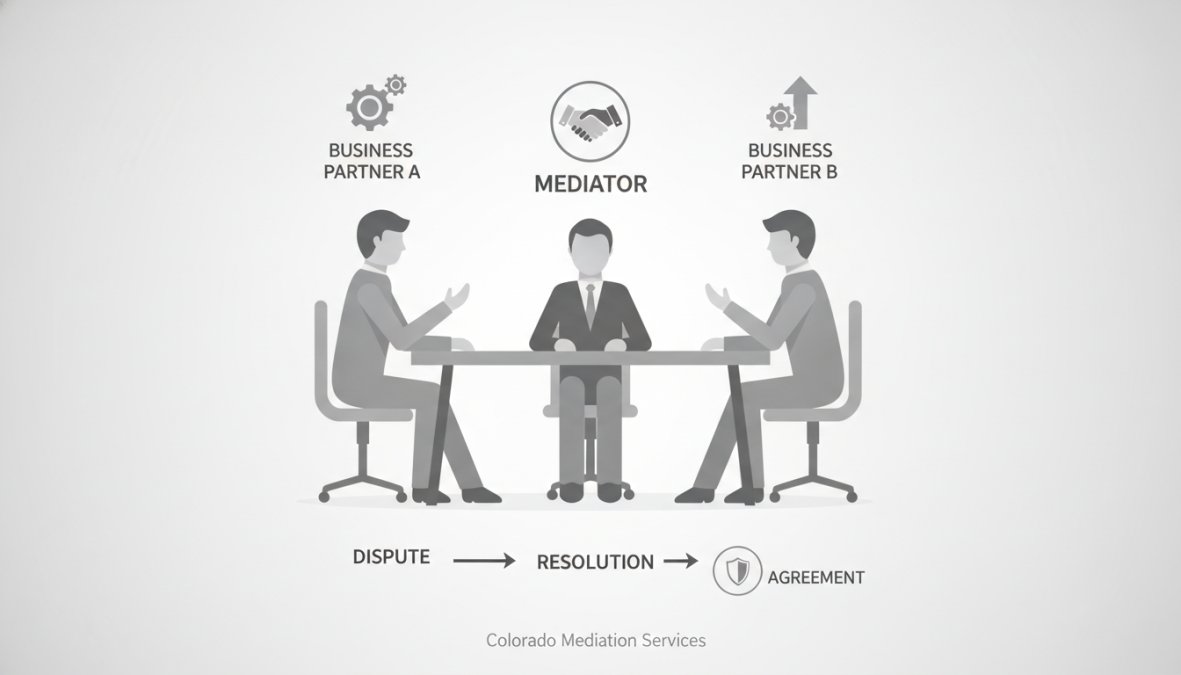
How mediation differs from litigation
Litigation is adversarial, a judge or jury decides winners and losers. It’s public, expensive, and takes 18-36 months. Even winners lose because the relationship is destroyed and business suffers.
Mediation is collaborative. Both partners work with a mediator to find solutions addressing each party’s core interests. It’s confidential, costs a fraction of litigation, and typically concludes within weeks. Both partners can win because the focus is solving the problem, not proving fault.
What to expect in the mediation process
Initial consultation. You meet with the mediator separately to explain the dispute, clarify goals, and understand the process. If you’re exploring mediation as an option, a free courtesy consultation can help you understand whether mediation is the right approach for your specific situation.
Joint opening session. Both partners explain their perspective without interruption. The mediator listens and outlines the process ahead.
Private caucuses. The mediator meets separately with each partner to explore interests deeply and identify possible solutions. What you say in caucus is confidential unless you authorize sharing.
Negotiation and problem-solving. The mediator helps partners move from positions (“I want 60% of profits”) to interests (“I need my contribution valued and investment protected”). Once interests are clear, creative solutions often emerge.
Settlement agreement. If agreement is reached, the mediator drafts a written settlement outlining the resolution and may include provisions for future conflict resolution.
The entire process typically takes 2-4 sessions over 4-8 weeks. Many partnerships report mediation not only resolves immediate disputes but rebuilds communication and trust.
Mediation works best when both partners genuinely want to find a solution. If one partner is stalling while planning litigation, the process will fail.
Partnership Agreement Clauses for Dispute Resolution
A strong partnership agreement includes specific clauses guiding how disputes will be handled, preventing disputes from escalating into expensive legal warfare.
Essential clauses to include
Dispute resolution hierarchy specifies the steps partners will follow: direct negotiation, then mediation, then arbitration or litigation. This gives both parties time to resolve issues before involving lawyers.
Mediation requirement mandates good faith mediation before litigation. This single clause has saved countless partnerships from the courtroom.
Confidentiality and non-disparagement protect the business while disputes are resolved.
Deadlock resolution specifies how to break ties in 50/50 partnerships through buyout formulas, business sale, or neutral arbitration.
Buy-sell provisions specify what happens if one partner exits, including valuation methods, payment terms, and right of first refusal.
Dispute resolution clause specifies mediation and binding arbitration rather than litigation, and may specify governing law and location.
The most effective agreements follow this progression:
- Direct negotiation (30 days)
- Mediation (30-60 days)
- Arbitration or litigation (if necessary)
This hierarchy gives both partners a final opportunity to control the outcome rather than surrendering control to a judge or jury. Work with a business attorney to ensure clauses are specific to your situation and enforceable in your state.
Legal Options for Partnership Disputes Beyond Mediation
If mediation doesn’t resolve the dispute or one partner refuses to participate, the partnership enters the legal arena.
Arbitration vs. litigation: key differences
Arbitration is a private process where a neutral arbitrator hears both sides and makes a binding decision. It’s faster (3-6 months vs. 18-36 months), more confidential, and often less expensive than litigation. However, arbitration decisions are binding with limited appeal options.
Litigation is a public court process where a judge or jury decides the dispute. It’s slower, more expensive, and more adversarial. Litigation decisions can be appealed and provide stronger discovery rights, but the public record may expose sensitive information.
Many partnership agreements specify arbitration as the final step before settlement, keeping disputes private and moving toward resolution faster.
When dissolution becomes necessary
Sometimes the partnership can’t be saved. In these cases, dissolution may be the best option.
Partnership dissolution involves determining what the partnership owns, valuing the partnership, dividing assets and liabilities according to ownership percentages, handling client and vendor relationships, addressing tax implications, and settling final obligations.
A clean dissolution requires clear communication, honest financial accounting, and often help from a business attorney and accountant. The alternative, a messy dissolution fought through litigation, can take years and cost hundreds of thousands of dollars.
Dissolution without a clear plan damages the business value that both partners built. If dissolution is necessary, plan it carefully and professionally.
How to Resolve Partnership Disputes Without Losing the Business
While partners fight, the business suffers. Clients sense dysfunction. Employees become uncertain. Revenue declines. Effective dispute resolution addresses conflict while protecting business value.
Communication strategies that preserve relationships
Start with clarity about what you’re trying to achieve. Are you saving the partnership or exiting cleanly?
Use “I” statements rather than accusations. Instead of “You’re destroying the business,” try “I’m concerned our current direction isn’t sustainable, and I’d like to discuss alternatives.”
Separate the person from the problem. Your partner isn’t bad, they have different priorities or perspectives. Addressing the specific issue keeps doors open.
Listen to understand, not to win. Most partners spend listening time preparing rebuttals rather than actually hearing the other person. Listening often reveals the real disagreement differs from assumptions.
Acknowledge your partner’s concerns even if you disagree. “I hear you’re worried about cash flow, and that’s legitimate” validates their perspective without conceding your position.
Managing the emotional toll of disputes
Partnership disputes are emotionally exhausting. Acknowledge emotions rather than suppressing them. Anger, disappointment, and betrayal are normal.
Separate your identity from the partnership. Many founders define themselves through their business. Partnership failure isn’t personal failure, it’s a business arrangement outcome.
Prioritize sleep, exercise, and nutrition. Exactly when you need to be sharp, stress makes you less effective. Consider talking with a therapist, emotional support matters as much as legal strategy.
Give yourself permission to grieve. If the partnership is ending, you’re losing something you built. That’s worth mourning.
Common Mistakes to Avoid When Resolving Partnership Disputes
Delaying action and letting disputes escalate
Unaddressed conflicts grow. Resentment compounds. Communication breaks down. What could have been resolved with one conversation becomes a multi-year legal battle. Address disputes as soon as they surface.
Skipping the partnership agreement review
Many partnerships operate without clear agreements or have outdated ones. Before disputes emerge, review your partnership agreement. If you don’t have one, get one drafted. If outdated, update it.
Jumping directly to litigation without exploring alternatives
Litigation is expensive, slow, and adversarial. Explore negotiation and mediation first. These are faster, cheaper, and more likely to preserve the business and relationship. Litigation should be a last resort.
Allowing emotions to drive decisions
When angry or hurt, judgment is compromised. Before making major decisions, wait 24 hours, talk with a trusted advisor, get perspective, then decide.
Ignoring the business while fighting
Partners focused on winning arguments neglect the business. Clients suffer. Employees become confused. Opportunities are missed. Whatever else happens, the business must continue functioning. Establish boundaries between dispute resolution and daily operations.
Conclusion: Your Next Steps
Partnership disputes are common but don’t have to be catastrophic. By understanding root causes, following structured resolution processes, and addressing conflicts early, most partnerships can resolve disputes without destroying the business or relationship.
If the partnership can be saved, focus on communication and finding solutions addressing both partners’ core interests. If the partnership needs to end, plan dissolution carefully to protect business value and personal reputation.
Resolving partnership disputes requires both strategic clarity and emotional intelligence. When internal efforts stall, a neutral professional guiding the process makes the difference between resolution and prolonged conflict.
| Resolution Method | Timeline | Cost Level | Outcome Type | Best For |
|---|---|---|---|---|
| Direct Negotiation | 1-4 weeks | Minimal | Collaborative agreement | Early-stage disputes, willing partners |
| Mediation | 4-8 weeks | Low-Moderate | Facilitated settlement | Stuck negotiations, relationship preservation |
| Arbitration | 3-6 months | Moderate-High | Binding decision | Faster resolution, confidentiality needed |
| Litigation | 18-36 months | High-Very High | Court judgment | Last resort, significant stakes |
Frequently Asked Questions
How do I know if mediation will actually work when my co-founder and I can barely communicate without tension?
Mediation works by introducing a neutral third party trained in interest-based resolution, not positional debate. The mediator creates a structured environment where emotions are managed and focus shifts from winning to problem-solving. Even partners with significant friction often find that this shift in format allows genuine communication to resume. Mediation is specifically designed for situations where direct negotiation has stalled, making it ideal when tensions are high.
What are the main legal options for partnership disputes if mediation doesn’t resolve the issue?
If mediation doesn’t succeed, you have several legal options for partnership disputes: binding arbitration (faster and more private than court), litigation (formal courtroom proceedings), or dissolution if the partnership is unsalvageable. Arbitration offers a middle ground, a neutral arbitrator makes a binding decision without the public exposure of litigation. Your partnership agreement often specifies which path applies, so review that document first before pursuing legal remedies.
How does a solid partnership agreement help prevent and resolve disputes?
A well-drafted partnership agreement includes dispute resolution clauses that outline the steps partners must follow, typically starting with negotiation, then mediation, then arbitration or litigation if needed. It also clarifies roles, profit-sharing, decision-making authority, and exit scenarios, which eliminates ambiguity that often fuels disputes. When disagreements arise, the agreement serves as your roadmap and often reduces the need for expensive legal intervention by establishing clear expectations upfront.
Is mediation confidential, and can what we discuss be used against us in court later?
Yes, mediation is confidential. Communications during mediation are typically protected by law and cannot be used as evidence in court if the process fails. This legal protection encourages honest dialogue without fear of giving away leverage. However, confirm confidentiality terms with your mediator upfront, as some agreements may have exceptions. This protection is one of mediation’s biggest advantages over litigation, where every statement can become part of the court record.
EXTERNAL SOURCES REFERENCED:
[EXTERNAL_LINK: American Arbitration Association guidelines on commercial mediation | adr.org]
[EXTERNAL_LINK: American Bar Association resources on partnership agreements and dispute resolution | americanbar.org]
[EXTERNAL_LINK: Harvard Law School Program on Negotiation research on conflict resolution effectiveness | pon.harvard.edu]
